
Details
DRM: Digitales Wasserzeichen
Weitere Details
1. Auflage 2022
23.09.2022
English
25.90 MB
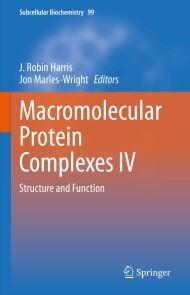
Macromolecular Protein Complexes IV
eBook - Structure and Function, Biomedical and Life Sciences (R0)
Beschreibung
This book covers the latest findings of a wide variety of viral, prokaryotic and eukaryotic macromolecular protein complexes and builds upon the solid macromolecular foundations established by previous volumes of theSubcellular Biochemistry series. Thus, an almost encyclopaedic coverage of the broad field of protein complex structure and function has been established.
The 17 interesting chapters included in this book have been organised into four sections: Soluble Protein Complexes, Membrane Protein Complexes, Fibrous Protein Complexes and Viral Protein Complexes. Significant topics present here are: Fatty Acid Synthase, the Fork Protection Complex, Ribonucleotide Reductase, the Kinetochore, G proteins, the FtsEX Complex, the Kainate Receptor, the Photosystem I-antenna, the Mycobacterial Arabinofuranosyltransferases, the the Bacterial Flagellum, the Actomyosin Complex, Motile Cilia, SLS Collagen Polymorphic Structures, and the Reovirus Capsid and Polymerase. Up-dates/expansion of chapter topics present in earlier volumes are now included in chapters here, e.g., those on Ferritin-like proteins and the Multi-tRNA Synthetase.
The book is richly illustrated throughout, the result of an impressive integration of structural data from X-ray crystallography and cryo-electron microscopy. The functional aspects of protein-protein interactions are also given a high priority.
Über J Robin Harris, Jon Marles-Wright
Jon Marles-Wright obtained his PhD in structural biology from the University of Oxford, where he focused on understanding how human immune receptors interact with their targets. For his post-doctoral training he moved to the University of Newcastle, where his research focus moved to bacterial cell biology. In 2012 Jon was appointed to a two-year career development fellowship at the University of Newcastle where he developed his interest in the structural basis of metabolic compartmentalization within bacteria. This was followed by nearly four years at The University of Edinburgh as a Chancellor¿s Fellow in the Institute of Structural and Molecular Biology and Centre for Systems and Synthetic Biology. Jon is currently a Senior Lecturer in Microbial Biotechnology in the School of Biology at Newcastle University.
Inhalt
E-Book Informationen
Alle hier erworbenen E-Books können Sie in Ihrem Kundenkonto in die kostenlose PocketBook Cloud laden. Dadurch haben Sie den Vorteil, dass Sie von Ihrem PocketBook E-Reader, Ihrem Smartphone, Tablet und PC jederzeit auf Ihre gekauften und bereits vorhandenen E-Books Zugriff haben.
Um die PocketBook Cloud zu aktivieren, loggen Sie sich bitte in Ihrem Kundenkonto ein und gehen dort in den Bereich „Downloads“. Setzen Sie hier einen Haken bei „Neue E-Book-Käufe automatisch zu meiner Cloud hinzufügen.“. Dadurch wird ein PocketBook Cloud Konto für Sie angelegt. Die Zugangsdaten sind dabei dieselben wie in diesem Webshop.
Weitere Informationen zur PocketBook Cloud finden Sie unter www.meinpocketbook.de.
Allgemeine E-Book-Informationen
E-Books in diesem Webshop können in den Dateiformaten EPUB und PDF vorliegen und können ggf. mit einem Kopierschutz versehen sein. Sie finden die entsprechenden Informationen in der Detailansicht des jeweiligen Titels.
E-Books ohne Kopierschutz oder mit einem digitalen Wasserzeichen können Sie problemlos auf Ihr Gerät übertragen. Sie müssen lediglich die Kompatibilität mit Ihrem Gerät prüfen.
Um E-Books, die mit Adobe DRM geschützt sind, auf Ihr Lesegerät zu übertragen, benötigen Sie zusätzlich eine Adobe ID und die kostenlose Software Adobe® Digital Editions, wo Sie Ihre Adobe ID hinterlegen müssen. Beim Herunterladen eines mit Adobe DRM geschützten E-Books erhalten Sie zunächst eine .acsm-Datei, die Sie in Adobe® Digital Editions öffnen müssen. Durch diesen Prozess wird das E-Book mit Ihrer Adobe-ID verknüpft und in Adobe® Digital Editions geöffnet.